
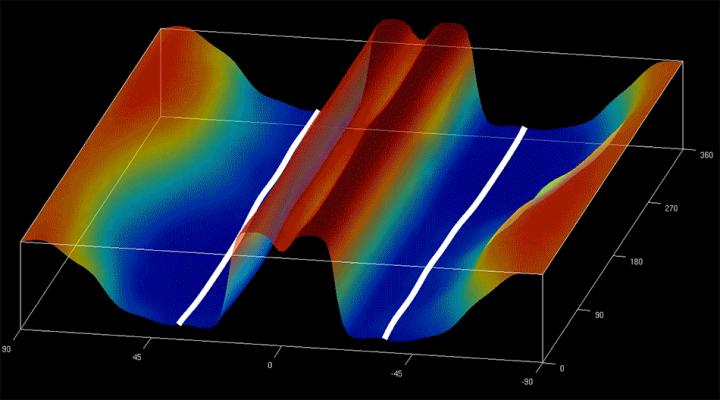
In a pair of new papers, scientists paint a picture of how solar cycles suddenly die, potentially causing tsunamis of plasma to race through the Sun’s interior and trigger the birth of the next sunspot cycle only a few short weeks later.
The new findings provide insight into the mysterious timing of sunspot cycles, which are marked by the waxing and waning of sunspot activity on the solar surface. While scientists have long known that these cycles last approximately 11 years, predicting when one cycle ends and the next begins has been challenging to pin down with any accuracy. The new research could change that.
In one of the studies, which relies on nearly 140 years of solar observations from the ground and space, the scientists are able to identify “terminator” events that clearly mark the end of a sunspot cycle. With an understanding of what to look for in the run up to these terminators, the authors predict that the current solar cycle (Solar Cycle 24) will end in the first half of 2020, kicking off the growth of Solar Cycle 25 very shortly after.
In a second study, motivated by the first, scientists explore the mechanism for how a terminator event could trigger the start of a new sunspot cycle using a sophisticated computer model. The resulting simulations show that “solar tsunamis” could provide the connection and explain the Sun’s remarkably rapid transition from one cycle to the next.
Both studies were led by the National Center for Atmospheric Research (NCAR).
“The evidence for terminators has been hidden in the observational record for more than a century, but until now, we didn’t know what we were looking for,” said NCAR scientist Scott McIntosh, who directs the center’s High Altitude Observatory and worked on both studies. “By combining such a wide variety of observations over so many years, we were able to piece together these events and provide an entirely new look at how the Sun’s interior drives the solar cycle.”
The research was funded by the National Science Foundation, which is NCAR’s sponsor, NASA’s Living with a Star program, and the Indo-US Joint Networked R&D Center.
Flickers of light reveal mysteries
Sunspot cycles are born after solar minimum, a period when the face of the Sun is quiet. As the cycle continues, more and more sunspots emerge, first appearing at about 35 degrees latitude in both hemispheres and slowly marching toward the equator over a decade before they fade again into the next solar minimum. The rough midpoint of this progression is solar maximum, when sunspots are the most abundant.
Predicting the timing of sunspot evolution is a major scientific goal, in part because sunspot activity is tied to the solar storms that can disrupt Earth’s upper atmosphere and affect GPS signals, power grids, and other critical technologies. But such predictions have proven challenging.
For example, the Sun is currently in a solar minimum. Scientist know the relative peace means that the current solar cycle is wrapping up, but it has been difficult to say whether the new cycle will begin in a few months or a few years. McIntosh and his colleagues think their studies can provide more clarity, both into the timing of cycles and also into what drives the cycles themselves.
The researchers began by studying the movement of coronal bright points – ephemeral flickers of extreme ultraviolet light in the solar atmosphere. By observing bright points, which occur even in the relative calm of a solar minimum, the scientists think they have gained a more complete view of the solar cycle than if they focused only on sunspot activity.
The bright points first appear at higher latitudes than sunspots (around 55 degrees) and migrate toward the equator at approximately 3 degrees latitude per year, reaching the equator after a couple decades. The paths traced by the bright points overlap with sunspot activity in the mid-latitudes (around 35 degrees) until they both reach the equator and disappear. This disappearance, which the researchers call a terminator event, is followed very shortly after with a large burst of bright point activity at the mid-latitudes, marking the beginning of the next sunspot cycle.
In the new study that identifies terminator events, published in the journal Solar Physics, the scientists corroborate the bright point observations with a number of other observations from a variety of spacecraft- and ground-observing facilities stretching back over 13 solar cycles.
“We were able to identify these terminators by looking at data from a whole range of different measures of solar activity – magnetic fields, spectral irradiance, radio flux – in addition to the bright points,” said University of Maryland scientist Bob Leamon, a co-author of the paper who is also a researcher at NASA’s Goddard Space Flight Center. “The results demonstrate that you really need to be able to step back and use all the available data to appreciate how things work – not just one spacecraft or one observation or one model.”
Tsunami connections
McIntosh and his team have identified that coronal bright points allow them to better “see” the solar cycle unfolding. But why does the sunspot cycle start surging in the midlatitudes a few weeks after the terminator?
The paper on solar tsunamis, led by NCAR scientist Mausumi Dikpati and published in Scientific Reports, explores the possible mechanisms behind the observations. It suggests that coronal bright points are markers for the movement of the Sun’s “toroidal magnetic fields,” which wrap around the Sun like rubber bands stretching in the east-west direction and migrate slowly toward the equator over the same two decades.
When these toroidal magnetic fields bob to the surface, they create sunspots along with the bright points they were already producing. As they travel, they also act as magnetic dams, trapping plasma behind them. When the toroidal magnetic fields from the Sun’s northern and southern hemispheres touch in the middle, their opposing charges cause their mutual annihilation, releasing the pent-up fluid behind them in a tsunami. This fluid rushes forward, collides, and then ripples backward, traveling toward the poles at a rate of about 300 meters per second.
As the solar tsunami reaches the Sun’s mid-latitudes, it encounters the toroidal magnetic fields of the next cycle, which are already marching toward the equator (this progression is marked by the path of coronal bright points) but traveling deeper within the Sun’s interior. The tsunami buoys those magnetic fields, lifting them toward the surface and producing the remarkable surge of bright points – and accompanying sunspot activity – that marks the beginning of the new sunspot cycle.
“We have observed the sunspot cycle for hundreds of years, but it’s been a mystery what mechanism could transport a signal from the equator, where the cycle ends, to the Sun’s mid-latitudes, where the next cycle begins, in such a relatively short amount of time,” said Dikpati.
As a body, the research provides a new way of thinking about the workings of the solar interior that challenges some of the conventional thinking about processes on the Sun. Whether or not the research is on the right track – and could improve our predictive capabilities – will soon get its first test.
There are a number of instruments that are ideally suited to observe the inevitable end of the current solar cycle and the start of the next, according to the authors. These include the Parker Solar Probe, which launched last August, the STEREO-A spacecraft, the Solar Dynamics Observatory, the Daniel K. Inouye Solar Telescope, and other assets.
“In the next year, we should have a unique opportunity to extensively observe a terminator event as it unfolds and then to watch the launch of Sunspot Cycle 25,” McIntosh said. “We believe the results, especially if the terminator arrives when predicted, could revolutionize our understanding of the solar interior and the processes that create sunspots and shape the sunspot cycle.”